publications
publications by categories in reversed chronological order. generated by jekyll-scholar.
2026
-
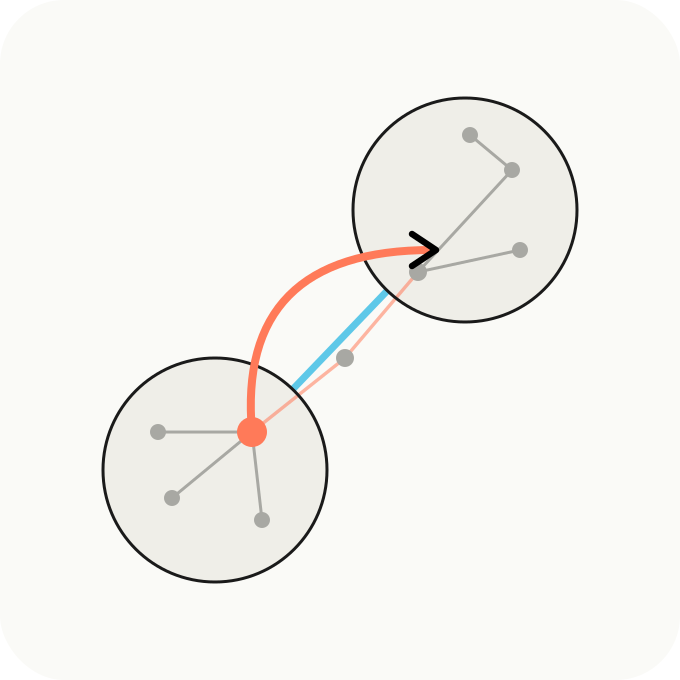 The Role of Professional Networks and Institutional Prestige in Shaping the First Career Moves of ScholarsAlexandra Rottenkolber, Ola Ali, Gergely Mónus, and 4 more authorsPNAS Nexus, 2026
Mobility of researchers is closely linked to knowledge diffusion, scientific innovation, and international collaboration. While prior research highlights the role of networks in shaping migration flows, the extent to which personal and institutional ties influence the direction of scientific mobility remains unclear. This study leverages large-scale digital trace data from Scopus, capturing the complete mobility trajectories, co-authorship networks, and collaboration histories of 172,000 authors over two decades (1996–2020). Using multinomial and conditional multinomial logit models, we examine scholars’ first career move by (i) classifying moves into four network-defined mobility-type categories and (ii) modelling destination choice as a function of co-authorship connection strength, institutional linkages, and institutional prestige. Our findings show that not only first-, but also second-order co-authorship ties — connections to a scholar’s collaborators’ collaborators — are a strong correlate of the direction of a move. Scholars with extensive individual professional networks, particularly those migrating abroad, are more likely to move along individual ties. In contrast, scholars from prestigious institutions, and those moving within national borders, are more likely to follow institutional routes. The destination-choice models confirm that both individual and institutional ties are associated with a higher probability of moving to specific research institutions, with a larger estimated association for individual than for institutional ones. Overall, this research provides empirical evidence on how individual and institutional connections shape scholars’ first career mobility. The findings have important implications for migration theory and policy, emphasising the need to support both individual and institutional collaboration networks to foster global scientific and knowledge exchange.
@article{rottenkolberRoleProfessional2026,
  title = {The Role of Professional Networks and Institutional Prestige in Shaping the First Career Moves of Scholars},
  author = {Rottenkolber, Alexandra and Ali, Ola and M{\'o}nus, Gergely and Li, Jiaxuan and Kim, Jisu and Perrotta, Daniela and Akbaritabar, Aliakbar},
  year = {2026},
  journal = {PNAS Nexus},
  pages = {pgag168},
  issn = {2752-6542},
  doi = {10.1093/pnasnexus/pgag168},
  url = {https://doi.org/10.1093/pnasnexus/pgag168},
  urldate = {2026-05-19},
}

2025
-
 The Shielding Effect: How workplace segregation can countervail occupational segregationAlexandra Rottenkolber, Martin Arvidsson, Maria Brandén, and 1 more author2025Draft. Under R&R at ESR — can be shared upon request.
Occupational gender segregation remains a persistent phenomenon with major consequences for life outcomes. Traditional explanations focus on job characteristics, gendered preferences, and homophily — the tendency of individuals to prefer working with similar others. In this study, we propose a novel mechanism that refines our understanding of homophily in shaping occupational segregation: the shielding effect. The shielding e!ect suggests that individuals have a higher tolerance for working in an occupation in which they are the minority if their immediate workplace still satisfies their homophilic preferences. As a result, gendered sorting in workplaces can dampen occupational gender segregation by insulating individuals from broader occupational segregation. We demonstrate the prevalence of the shielding e!ect using Swedish register data. We examine how the gender composition of occupations and workplaces, and the inflows shaping those, interact to influence individuals’ decisions to stay in or exit their occupation. Our results strongly support that individuals surrounded by more same-gender co-workers at their workplace are more likely to remain in their occupation, regardless of (shifts in) the broader occupational gender composition. Using discrete choice models and counterfactual simulations, we estimate that the shielding e!ect absorbs up to 1/2 of the impact of occupational homophily in the Swedish context. This finding underscores the importance of workplace context in shaping broader patterns of segregation in the labour market.
@article{rottenkolber2025Shielding,
  author = {Rottenkolber, Alexandra and Arvidsson, Martin and Brandén, Maria and Takács, Károly},
  title = {The Shielding Effect: How workplace segregation can countervail occupational segregation},
  journal = {},
  year = {2025},
  volume = {},
  number = {},
  pages = {},
  doi = {},
  note = {<em>Draft</em>. Under R&R at ESR — can be shared upon request.},
  learn_more = {/assets/html/shielding-effect-simulation.html}
}
